Same Faces, Better Films: Why Indie Directors Keep Coming Back to the Same Crew
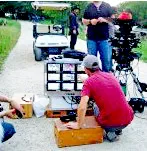
Photo: Civil War Attraction, CC BY-SA 4.0, via Wikimedia Commons
There's a moment on almost every indie set — usually somewhere around hour eleven, when the catering has run out and the light is doing something nobody planned for — where you realize the person standing next to you either gets it or they don't. They either lean into the chaos or they fold. And if they lean in? You remember that. You call them first next time.
That instinct, multiplied across a dozen projects and a handful of deeply trusted collaborators, is quietly reshaping how independent cinema gets made in America. Forget the romantic image of the lone auteur with a camera and a dream. The filmmakers building the most exciting bodies of work right now aren't doing it alone — they're doing it with the same people, over and over again, on purpose.
The Problem With Starting From Scratch
Every filmmaker who's ever posted a crew call on a Facebook group or scrolled through production listings knows the drill. You pull together a team of relative strangers, spend the first few days figuring out who actually delivers and who just interviewed well, and then — just when everyone's hitting their stride — the project wraps and you scatter. Six months later, you do it all over again with a mostly different group.
It's exhausting. And more than that, it's creatively expensive. The time you spend establishing shorthand with a new DP, calibrating expectations with a first-time AD, or explaining your visual sensibility to a production designer you've never worked with before? That's time and energy that could be going into the work itself.
Directors who've cracked this problem tend to say the same thing: the best creative decisions happen fast, and fast only happens when people already trust each other.
What a Real Creative Collective Looks Like
It doesn't have to be formal. Some of the most productive indie collectives in the country look nothing like a production company on paper. They're more like a standing roster — a cinematographer who's shot your last three shorts, a sound designer who texts you ideas at midnight, an editor who knows when you're trying to say something you haven't figured out how to articulate yet.
Take the model that's emerged out of cities like Atlanta, Chicago, and Austin, where scrappy indie scenes have given rise to filmmaker pods that cross-pollinate constantly. One director shoots her own feature while her DP directs a documentary — and they swap notes, share gear, and crew each other's projects without a second thought. The boundaries between "your film" and "our film" blur in the best possible way.
What makes these arrangements work isn't just friendship, though that helps. It's a shared aesthetic vocabulary. When you've watched someone make the same kinds of choices across multiple projects, you start to understand why they make them. And that understanding is worth more than any amount of technical skill you could hire for day rate.
The Artistic Case for Loyalty
Here's something the film school textbooks don't spend enough time on: creative risk-taking is directly tied to psychological safety. When a director trusts her crew, she's more likely to try the weird thing, push the uncomfortable scene, or throw out the shot list and follow something instinctual happening in front of the camera.
That kind of freedom is almost impossible to manufacture with strangers. It has to be earned, and it takes time.
Cinematographer and director duos have always understood this intuitively. Think about the way recurring collaborations — whether it's the Safdie brothers working consistently with their tight circle or micro-budget filmmakers like Josephine Decker building crews who follow her from project to project — produce a visual and tonal coherence that's hard to fake. The films feel like they come from somewhere real because the relationships behind them are real.
For emerging filmmakers, this is genuinely good news. You don't need to know everyone in the industry. You need to know the right five or six people deeply.
Building Your Bench: A Practical Blueprint
So how do you actually cultivate a crew that sticks around? A few things that working filmmakers swear by:
Treat your short films like rehearsal. The short film format exists, in part, to let you figure out who you want in the room when things get hard. Use it that way. Pay attention to who problem-solves well, who communicates clearly under pressure, and who leaves the set better than they found it.
Reciprocate. The fastest way to build a loyal crew is to show up for theirs. DP a friend's project. PA on your editor's short. Show people that your investment in them isn't transactional — it goes both ways.
Be explicit about the vision. Collaborators stay when they feel creatively invested, not just employed. Share your references, your obsessions, the films that broke your heart. Let people into the why, not just the what.
Create space for their ideas. The directors who build lasting crews tend to be the ones who aren't precious about where good ideas come from. If your gaffer has a lighting instinct that's smarter than your original plan, say so. That acknowledgment compounds over time.
Communicate between projects. A quick message when you see something that reminded you of a conversation you had on set. A coffee meeting to talk through the next idea before it's even a script. Relationships that only activate during production tend to fade. The ones that survive the gaps are the ones worth building on.
The Long Game
There's a sustainability argument here that doesn't get made often enough. Independent filmmaking is brutal in ways that have nothing to do with money — the isolation, the rejection, the sheer grind of getting anything made without institutional support. Having a crew that's genuinely in it with you changes the psychological math of that experience in ways that are hard to overstate.
When your editor has seen every cut of every project you've made together, they're not just a technical collaborator. They're a witness to your creative evolution. That matters. It keeps you honest, keeps you growing, and — on the days when the whole thing feels impossible — keeps you going.
The filmmakers who last in independent cinema aren't necessarily the most talented ones out of the gate. They're the ones who figured out, early, that this is a team sport. That the best version of your work lives somewhere in the overlap between your vision and the people you trust enough to challenge it.
Find those people. Keep them close. Make something together, and then make something else. The films will be better for it — and so will you.