Sidewalks to Screening Rooms: The Street Performers Rewriting the Rules of Indie Film
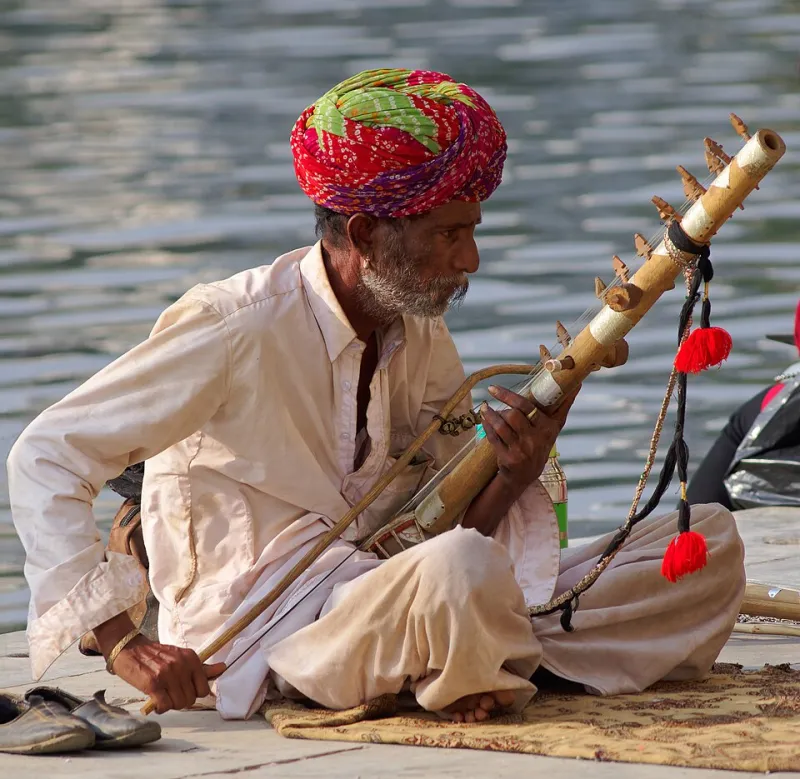
Photo: Jakub Hałun, CC BY-SA 4.0, via Wikimedia Commons
There's a specific kind of courage involved in opening a guitar case on a busy street corner, setting up, and just... playing. No guarantee anyone stops. No algorithm nudging people toward you. Just raw talent, a little nerve, and the hope that what you're putting out into the world connects with somebody passing by.
Sounds a lot like making an independent film, right?
That's not a coincidence. Across the country, a loose but growing community of emerging filmmakers is finding deep creative kinship with busking culture — the art of street performance — and channeling that energy into some of the most authentic, character-driven work showing up on the indie festival circuit right now.
The Stripped-Down Philosophy
Busking strips performance down to its absolute essentials. You've got your instrument, your voice, your body, and maybe a handwritten sign. There's no production budget, no safety net, and no second chances with a crowd that's already halfway to the coffee shop. That kind of radical immediacy, the pressure to be real or be ignored, is something a lot of indie directors are actively chasing.
Marcus Teller, a 29-year-old director based in Atlanta, spent three years busking with a spoken word act in Little Five Points before he ever touched a camera. He describes the transition as almost seamless in terms of mindset.
"When you're on the street, you learn really fast that pretension doesn't work," Teller says. "People can smell inauthenticity. They'll just walk past you. Filmmaking felt exactly the same when I started — if the story isn't honest, audiences check out. They might not physically walk away, but you lose them."
His debut short, Corner Store Elegy, shot over a single weekend in his grandmother's neighborhood for under $3,000, screened at the Atlanta Film Festival and earned him a mentorship through a regional filmmaker development program. The film's unhurried, observational quality — long takes, natural light, non-professional actors — feels less like a stylistic choice and more like a direct inheritance from his time performing on sidewalks.
Minimal Resources, Maximum Presence
One of the most practical overlaps between busking and low-budget filmmaking is the creative problem-solving that resource scarcity demands. Street performers figure out how to be compelling with whatever they've got. Indie filmmakers are doing the same thing — and increasingly, they're embracing that limitation as an aesthetic identity rather than a compromise.
Director Priya Anand, who grew up watching her older brother busk with a handpan drum outside Pike Place Market in Seattle, talks about "the busker's economy" as a guiding principle in her work.
"My brother could create this entire emotional world with one instrument and a few square feet of sidewalk," she explains. "That taught me early on that scale isn't the point. Presence is the point. You don't need a crane shot if you have a face that the camera loves and a story worth telling."
Anand's debut feature, Meridian, was shot in 18 days across three Pacific Northwest locations with a crew of seven. It premiered at the Seattle International Film Festival last spring to strong notices, with critics consistently highlighting its intimacy and emotional precision — qualities Anand traces directly back to that stripped-down philosophy.
The Skeptical Crowd Problem
Here's the thing about busking that nobody really talks about: most people aren't stopping for you. The default is indifference. The crowd is skeptical, distracted, and has somewhere else to be. The performers who survive and thrive in that environment have developed something genuinely rare — the ability to earn attention rather than assume it.
For indie filmmakers navigating a saturated market, that particular skill set is basically a superpower.
"Film festivals are crowded," says Javier Reyes, a Chicago-based filmmaker whose short Laundromat Hours has screened at over 40 festivals in the past year. "There are hundreds of films competing for attention. The directors who cut through are the ones who understand that you have to earn every minute of a viewer's time. You can't just expect people to care."
Reyes isn't a performer himself, but he spent two years documenting Chicago's busking community for a web series before pivoting to narrative filmmaking. That immersion, he says, fundamentally changed how he thinks about audience engagement.
"I watched performers figure out in real time what was working and what wasn't. There's this constant calibration happening — reading the crowd, adjusting, staying present. I brought all of that into how I think about pacing, about when to linger and when to cut."
Authenticity as Currency
Perhaps the most significant thing busking culture offers indie filmmaking is a model for authenticity as a competitive advantage. In an industry where the biggest productions are chasing spectacle, the filmmakers drawing from street performance traditions are betting on something different — emotional truth, human-scale storytelling, and the kind of specificity that makes a film feel like it could only have been made by one particular person.
That's a bet that's increasingly paying off. The festival landscape has shifted noticeably in recent years toward rewarding exactly these qualities. Programmers at Sundance, SXSW, and Tribeca have all spoken publicly about a hunger for films that feel genuinely personal — work that carries the fingerprints of its creator.
For the filmmakers who grew up watching street performers command attention with nothing but talent and tenacity, that's not a trend. It's just the way they've always understood storytelling to work.
"A great busker makes you stop walking," says Teller. "A great film makes you forget you had somewhere else to be. That's the same magic. I'm just chasing it in a different medium."
Where the Street Meets the Screen
What's emerging from this intersection isn't a formal movement with a manifesto. It's more organic than that — a shared sensibility among filmmakers who've internalized the busker's code: show up, be real, earn it.
For Busk Films, that spirit is essentially the whole point. Cinema that dares to be different doesn't come from development deals and test screenings. It comes from people with something to say and the audacity to say it, whether that's on a street corner in Nashville or in a 15-minute short that's about to blow up at a festival in Austin.
The sidewalk and the screening room are closer than you think.